
Understanding How Mobile Network Towers Actually Work
Understanding How Mobile Network Towers Actually Work
Many people see telecom towers every day but very few truly understand what happens behind the scenes that allows their phones to make calls, send messages, and browse the internet.
As a telecom engineer, I find it important to occasionally explain the basic components that power mobile communication.
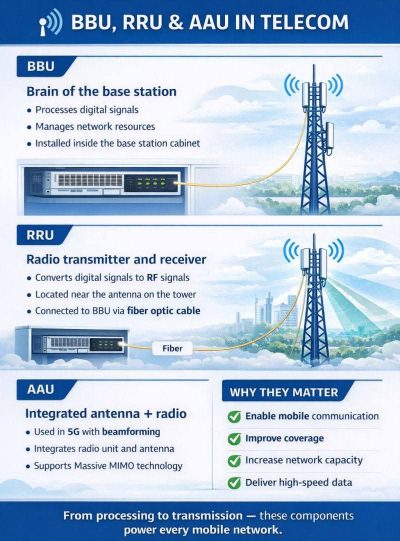
A typical telecom base station is built around three key components: BBU, RRU, and AAU.
1. Baseband Unit (BBU)
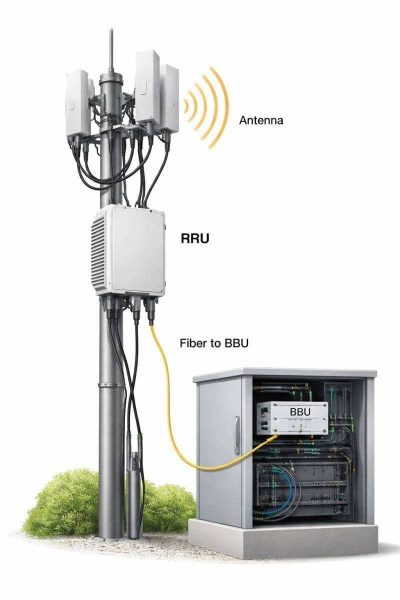
The BBU is essentially the brain of the base station. It processes all the digital signals coming from users’ devices and manages network resources. This unit is usually installed inside the equipment cabinet at the base of the tower or in a telecom shelter.
2. Remote Radio Unit (RRU)
The RRU acts as the radio transmitter and receiver. Its job is to convert the digital signals processed by the BBU into radio frequency (RF) signals that can travel through the air.
This unit is typically mounted close to the antenna on the tower and connected to the BBU through high-speed fiber optic cables.
3. Active Antenna Unit (AAU)
In modern networks, especially 5G, the antenna and radio are integrated into one device known as the AAU. This technology enables advanced features such as beamforming and Massive MIMO, which help deliver faster speeds, stronger signals, and better network capacity.
Why These Components Matter
Together, these systems:
• Enable mobile communication
• Improve signal coverage
• Increase network capacity
• Deliver high-speed data services
So the next time you see a telecom tower, remember that it is not just a metal structure. It is a carefully engineered system working around the clock to keep millions of people connected.
Understanding these technologies helps the public appreciate the complexity behind the mobile networks we rely on every day.
©️ Engr Oladimeji O Snr
HOLIDAYHOUSEAFRICA 🌍

COMMENTS